Pilih jalurmu
Lebih spesifik
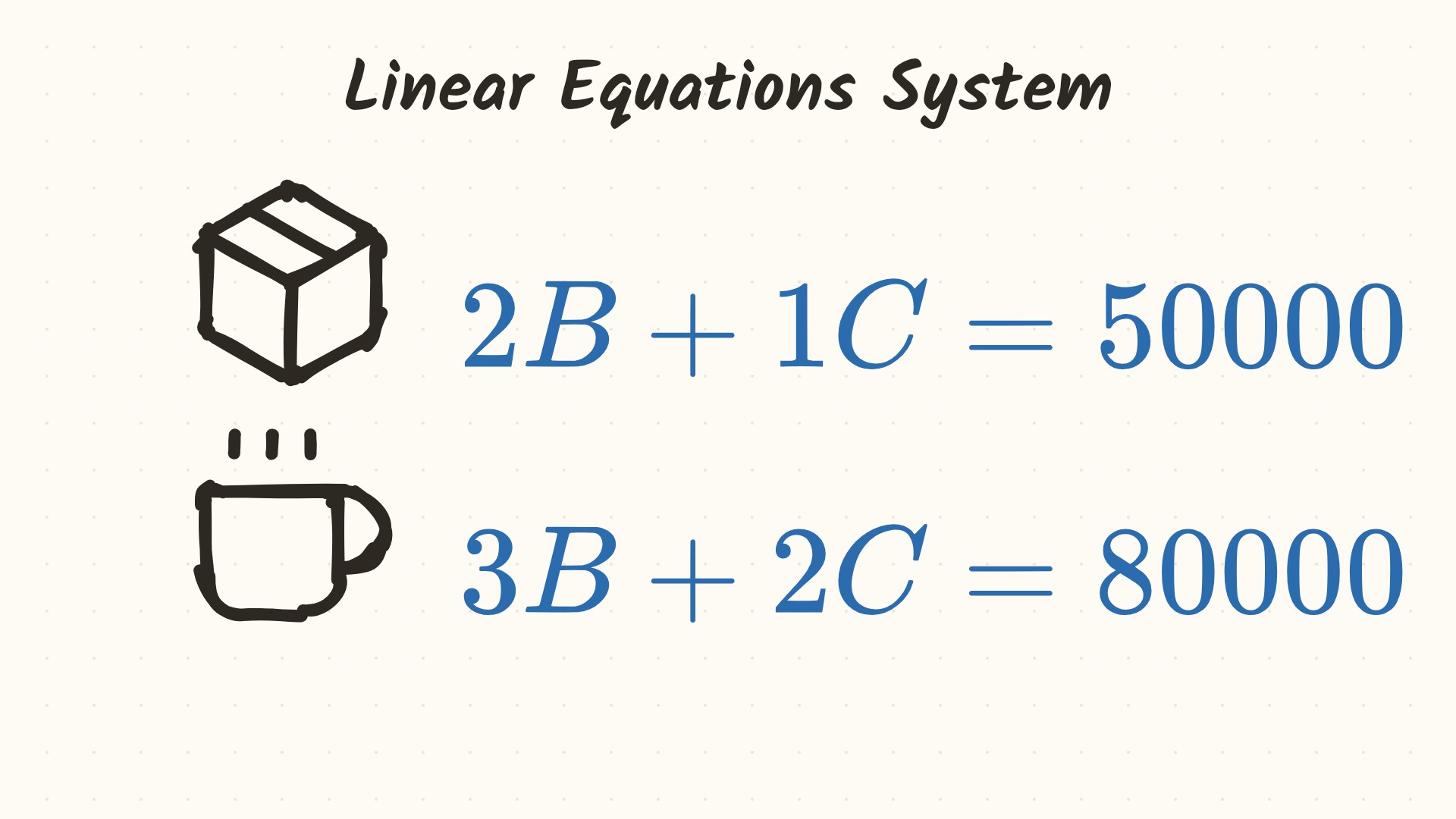
Ever tried guessing the price of one burger and one coffee after a friend pays fifty thousand for two burgers and one coffee, while another pays eighty thousand for three burgers and two coffees? Let's turn this story into a math model.
To find the prices, we use elimination. We want to remove one variable. Let's multiply the first equation by two. Now we have four B plus two C equals one hundred thousand. Subtract the second equation from it, and we get B equals twenty thousand.
Next, substitute this back. Two times twenty thousand plus C equals fifty thousand, so C is ten thousand. Visually, these two equations are lines, and their intersection point is exactly our solution! This is the general form a x plus b y equals c.
Here is a quick trick for exams. Students often fall into the trap of solving B and C individually. But what if they ask for five B plus three C? Don't solve individually! Just add the two original equations: you instantly get one hundred thirty thousand.
What if we add a third item, like fries? Now we have three variables: Burger, Coffee, and Fries. This forms a system of three linear equations, where the total depends on all three items.
The standard strategy is to reduce three variables down to two. You eliminate Fries from equations one and two, then from two and three. Now you are back to a familiar two-variable system.
For cyclic systems common in exams, don't eliminate one by one. If x plus y is ten, y plus z is fifteen, and x plus z is thirteen, just add them all! Two times x plus y plus z equals thirty eight, so the sum is nineteen.
To conquer quantitative problems, read the question first! Whether it's finding prices separately through elimination, or adding equations to find the total package price in seconds, always check what is asked.